

Case Study
Optimizing the Sales Process with a CRM
Client Background
Company: Espresso Events
Industry: Catering and event support services (mobile coffee carts, espresso bars, service at conferences, corporate meetings, weddings, etc.)
Target clients: Hotel managers and meeting/event planners
Challenges Identified Before the CRM
Espresso Events handled multiple lead-generation channels—website forms, email, social media, phone calls—but there was no unified system to manage lead flow, follow-ups, automated reminders, or integrated communications. This led to delays, errors, poor visibility into each lead’s status, and missed opportunities; in short, sales management wasn’t as effective and there was no real post-sale process.
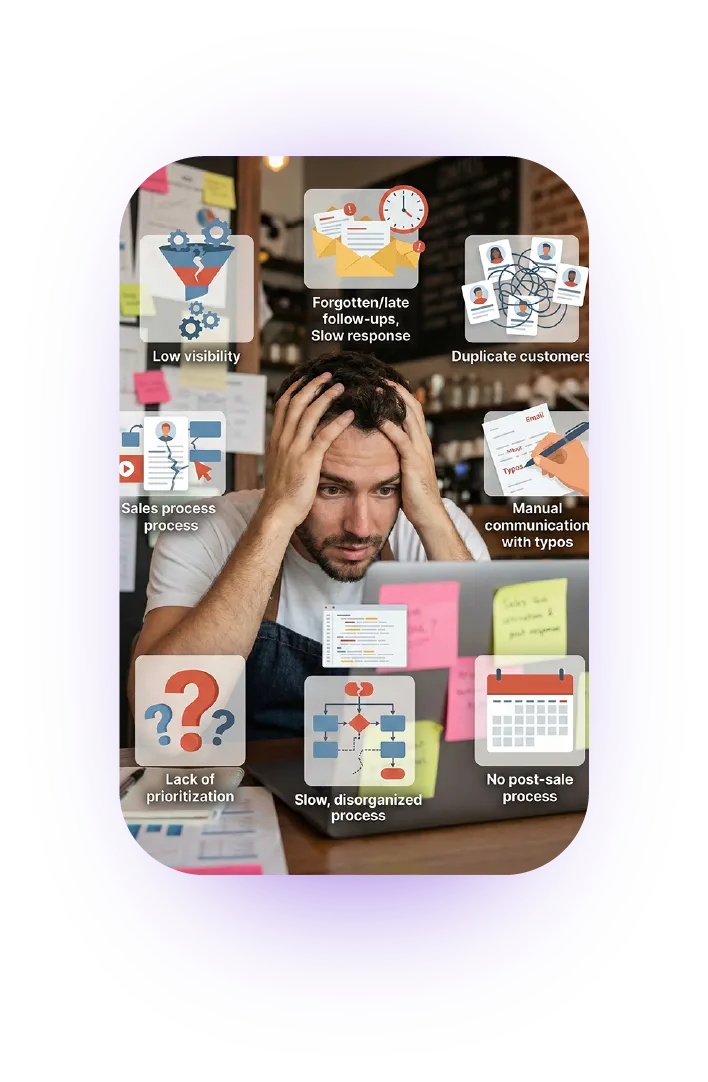
Some of the main issues Espresso Events faced:
Forgotten or late follow-ups: Leads went “cold” before receiving a proposal.
Duplicate customers or inconsistent data: Confusion among contacts from the same hotel under different names.
Low visibility into the sales funnel: No clarity on how many leads were in proposal, negotiation, or closing stages.
Manual, scattered communication: “Hand-crafted” emails without templates or automation, plus typos.
Slow response times: Clients could wait 24–48 hours to receive a quote.
Lack of prioritization: No insight into which leads had the greatest potential or urgency.
Slow, disorganized sales process: No clarity on each client’s stage; multiple tools created confusion and lost opportunities.
No efficient post-sale process: Many missed opportunities due to insufficient follow-up for future events with the same clients.
Implemented Solution
To fix this, a CRM system was implemented and integrated with the website to automate lead capture, assignment, reminders, follow-ups, and segmentation by service type.
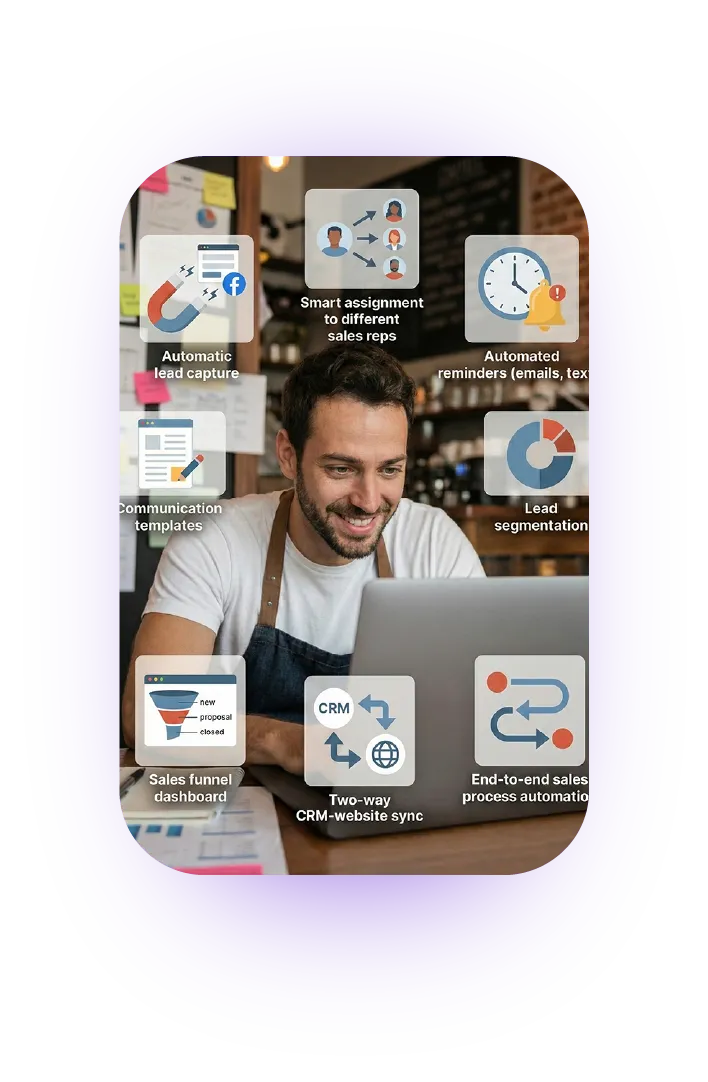
Automatic lead capture from the website (forms connected to the CRM) and other sources (social media and phone calls).
Automatic assignment to a sales rep by territory or event type.
Automated reminders and alerts for persistent follow-up (emails, calls, texts, internal reminders).
Communication templates for proposals, quotes, and follow-ups.
Lead segmentation/classification by service type (e.g., “espresso bar,” “full coffee service,” “corporate event,” “social event”).
Sales-funnel dashboard showing how many leads are in each stage (new, initial contact, proposal sent, negotiation, closed).
Two-way integration between the CRM and the website to keep data in sync and avoid manual duplicates.
End-to-end sales-process automation, from first contact through closing and post-sale follow-up.
Results Achieved
(Estimates Based on Typical Metrics)

Average initial response time
Before
24–48 hrs
After
4–8 hrs
Estimated Improvement
75%–83% reduction
Effective follow-up rate (within 3 days)
Before
40% of leads
After
85% of leads
Estimated Improvement
112% improvement
(more than double)
Duplication/inconsistent-data errors
Before
10% of records
After
2%
Estimated Improvement
80% reduction
Time spent on manual tasks (data entry, reminders, sends)
Before
~15 hrs/week per rep
After
~5 hrs/week
Estimated Improvement
66% time savings
Proposal turnaround (contact - quote sent)
Before
2 days avg
After
6 hours avg
Estimated Improvement
75% decrease
Lead-to-customer conversion
Before
8%
After
12%
Estimated Improvement
50% relative increase
Lead loss due to lack of follow-up
Before
30%
After
10%
Estimated Improvement
67% reduction
Sales cycle length (lead - close)
Before
30 days avg
After
18 days avg
Estimated Improvement
40% reduction
Pipeline lead quality (qualified vs. generic)
Before
30% qualified
After
60% qualified
Estimated Improvement
Quality doubled
What these improvements mean:
The sales team responded faster, building trust with demanding clients like hotels and professional planners.
With automated reminders and follow-ups, virtually no lead went unattended.
Fewer data errors improved the accuracy of segmentation and communications.
Less time on admin tasks meant more focus on strategic sales conversations.
A shorter sales cycle increased client turnover and revenue per period.
A higher share of qualified leads reduced wasted effort on low-potential prospects.
In addition, the sales process became 100% traceable and predictable, with a clear, automated structure that enables the team to:
Assign tasks logically.
Know which leads are ready to close.
Forecast revenue.
Make decisions based on real data, not gut feel.
Run organized, automated post-sale actions.
Conclusion
By implementing the CRM, Espresso Events moved from a fragmented, disorganized sales process to an automated, clear, and efficient system. The result was a faster operation with fewer errors, higher conversion, and a team focused on selling—not on organizing.
In a space where speed and professionalism are key, the CRM not only improved the end-customer experience but also boosted the company’s internal performance. Today, Espresso Events is better prepared to scale operations, serve more clients, and deliver memorable experiences… with a cup of coffee as the perfect excuse.
Let’s Start TOGETHER

GetIDX is operated by Intelligent Digital eXperience, formerly Imagine Digital eXpressions and previously known online as IDX.Marketing. We now specialize in CRM systems, lead follow-up, and automation support for growing businesses.
QUICK LINKS
CRM & RESOURCES
CONTACT US
8865 Commodity Circle Ste 14-101
Orlando – FL 32819
(321) 321-9222


© 2026 IDX. All Rights Reserved. Privacy Policy. Terms of Service. LLMs
© 2026 IDX. All Rights Reserved.